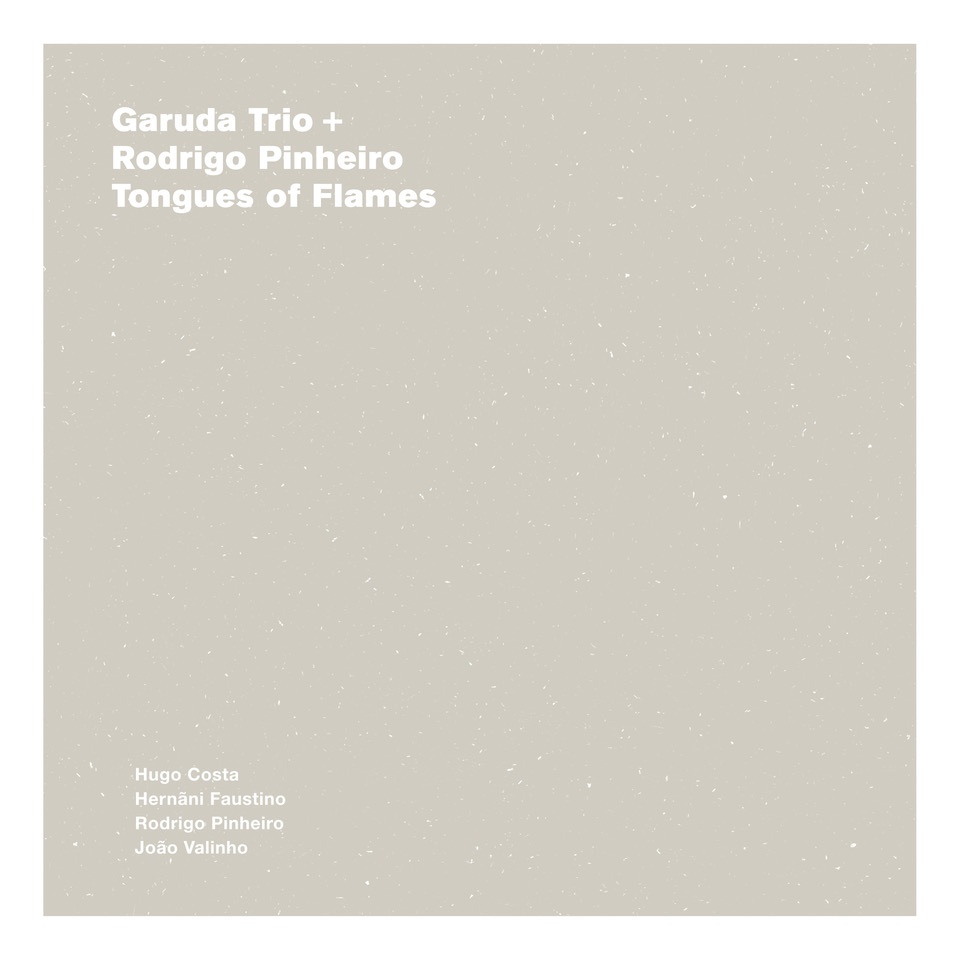
Tongues of flames
One of the most persistent presumptions about ‘free music’, is that it is supposed to be an attempt at total freedom, with at its very core a form-less mass of sound that remains shapeless, without references and devoid of coherence. Of course, it couldn’t be any further from the truth. Granted, free improvising musicians claim different kinds of freedom - the freedom to disregard some conventions and the freedom to opt for a different course are two key examples -, but the term ‘freedom’ usually gets a productive interpretation. While less bound to rules and limitations, the best free music out there is usually an act of collective construction. Applicable point in case: this second release by the Portuguese Garuda Trio, for which they are accompanied by pianist Rodrigo Pinheiro.
Rotterdam-based alto saxophonist Hugo Costa previously appeared on this label with Philipp Ernsting, one of his band mates in the pulverizing trio Albatre. Work with this band or his trio with Onno Govaert and Raoul van der Weide shows he’s also a highly personal and nuanced player, equally comfortable in more introspective, totally acoustic surroundings. In bass player Hernâni Faustino and drummer João Valinho, he finds two impressive foils. While Faustino recently impressed with Manifesto, a trio with Susan Alcorn and José Lencastre, he has been a cornerstone of Lisbon’s free music community for years. He’s a modest artist playing with effortless authority.
Valinho, on the other hand, made his entrance onto the scene only a few years ago, but is already one of the most adaptive players of the moment. Look no further than the two extremely divergent Clean Feed-releases he appeared on in 2023 (with MOVE & Bruno Parrinha’s Vine Leaf). Extra guest this time around is pianist Rodrigo Pinheiro, another crucial member of Lisbon’s creative music community and, like Faustino, also a RED Trio member and founder of the Phonogram Unit-label. Together, these four expertly navigate through divergent waters, from the sparse and introverted to the kinetic, with a keen sense of tension and an eye for detail.
Opener “Raw” is an exercise in musical bonding that manages to remain free and unfettered throughout a turbulent course while never losing its tight focus. The shorter “Tongue Of Flame” immediately packs a punch and slowly releases (some of) its tension in the second half, turning it into an alluring mirror image. “If We Dance” perhaps stays closer to the jazz tradition, without losing an unpredictable fickleness. Listen how these four move - perhaps dance is a more appropriate verb, indeed - around each other, and work with volume, density, textures, iridescent atmospheres and a finale in which lava-like energy morphs into something hypnotizing. The quartet somehow merges gravity with playfulness and never settles for conventionality, putting the act of spontaneous creation front and center.
That another Portuguese line-up pops up on this label is, admittedly, a cause for personal joy, but it also shows that this international scene is a supportive environment. More than ever before, international collaboration might offer the best way forward. We have all witnessed what artificial borders can lead to.
Guy Peters
Hugo Costa: alto saxophone
Hernâni Faustino: Double bass
Rodrigo Pinheiro: Piano
João Valinho: DrumsRecorded at Namouche studios in Lisbon, July , 2022 by Joaquim Monte
Mixed & Mastered by Daniele Martini
Sleeve notes: Guy Peters.
Layout: Rutger Zuydervelt
Executive label director: Dirk Serries.- March 1, 2024 — A New Wave of Jazz nwof0063
- CD