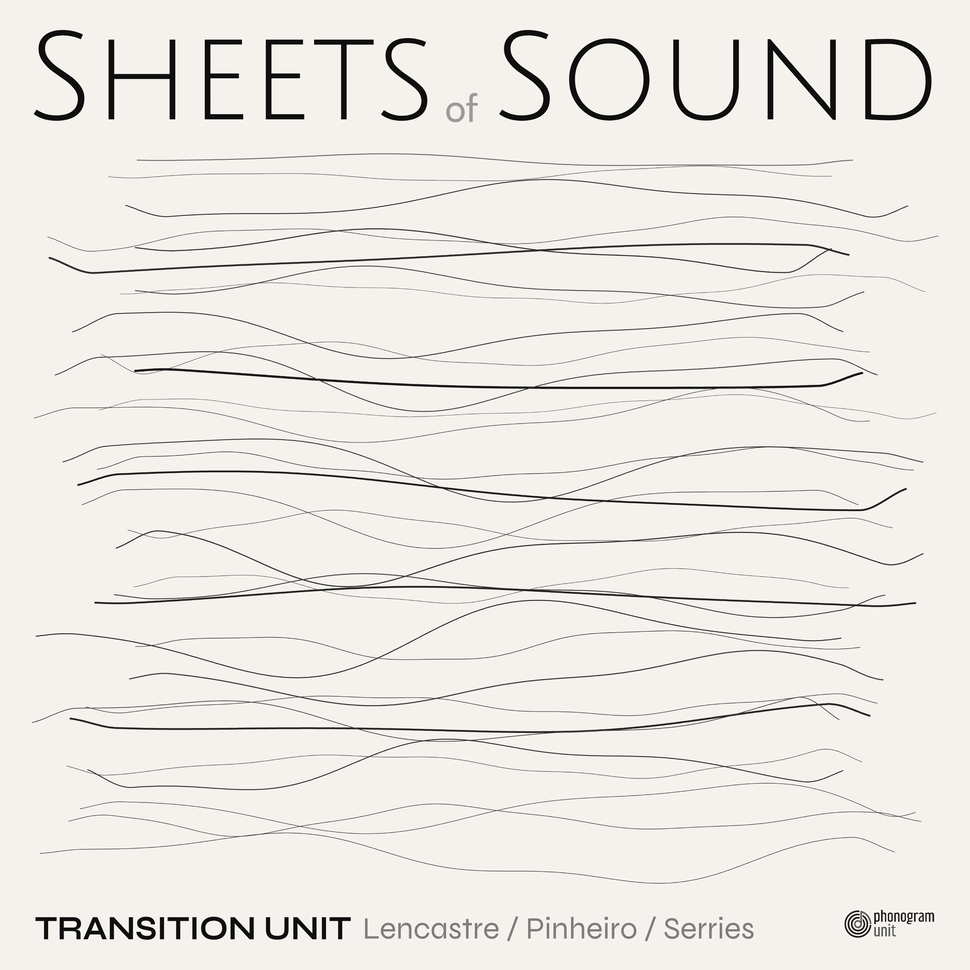
Sheets of Sound
Let us pretend, for a moment, that we are in 1958. John Coltrane is trying to relaunch his career after being fired from the Miles Davis quintet the previous year due to his heroin addiction. The dizzying improvisations he develops are described by critic Ira Gitler, in notes for “Russian Lullaby,” an original Irving Berlin piece included in Soultrane, released that year, as “sheets of sound.” [“I’m sure this Lullaby would keep Nikita (Khrushchev) awake and swinging all night.” he wrote.] The title chosen for this second album by Transition Unit — a group that is two-thirds Portuguese, with pianist Rodrigo Pinheiro and saxophonist José Lencastre, and one-third Belgian, with guitarist Dirk Serries — may not be related to Gitler’s expression, but that hardly matters. “I immediately found a connection to the music we made in the studio,” explains Pinheiro. “Each of us builds one or more layers with information that is sometimes different from the layers created by the other musicians.” This is an ensemble without double bass or drums and with two harmonic instruments, a characteristic that demands a more complete approach to music — especially the kind they are devoted to, improvised music — raising the bar of what is required. Rodrigo Pinheiro likes to call it an unbalanced trio. They pick up where everything had left off on their debut, Face Value, released in 2024 on A New Wave of Jazz, but they do not limit themselves to mere continuity, logical or illogical: Sheets of Sound is a decisive step forward in the creative intersection of distinct yet complementary musical personalities. This is no doubt connected to the experience of the three musicians having since performed live together, which allowed the organic quality of their interactions to grow exponentially. The album was recorded at the end of 2024 in a studio in Belgium equipped with a Blüthner piano from the dawn of the twentieth century, painstakingly restored. Despite its natural limitations when compared to modern instruments, this piano revealed a timbre and a charm that forced the pianist to play differently in order to draw out its full potential. The recording session lasted nearly two hours. The only prior arrangements concerned the beginnings and their respective intensities. The improvisations that emerged are free from hierarchies and subordination: the instruments are on equal footing in the sonic construction, listening levels are high, and the interaction is intimate. There is also a chamber music quality that underscores the acoustic dimension of the instruments.
António Branco, Lisbon, April 2026
- José Lencastre : alto sax
Rodrigo Pinheiro : piano
Dirk Serries : archtop guitar - Recorded, mixed and mastered at the Sunny Side Inc. Studio (Anderlecht, Belgium) on December 15th, 2024.
Liner notes by António Branco
Cover by Rodrigo Pinheiro
Production by Dirk Serries and Rodrigo Pinheiro
Executive Production by Phonogram Unit - April 17, 2026 — Phonogram Unit PU39DI
- Digital download